
Procedures
Pancreatic Pseudocyst: Symptoms and EUS Drainage
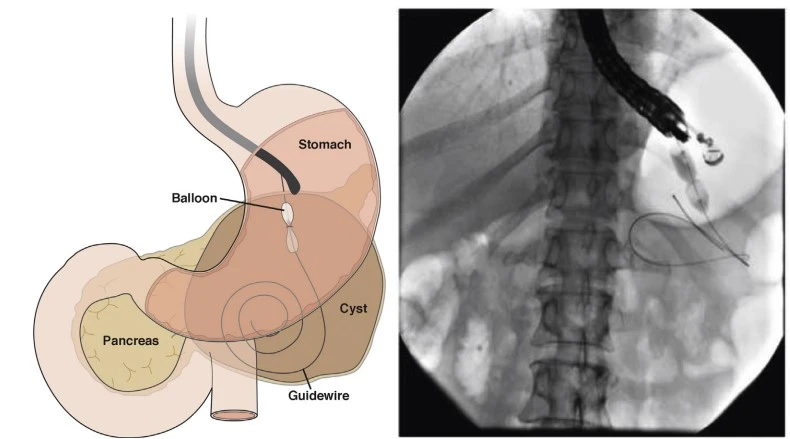
A pseudocyst usually turns up several weeks after the worst is over. The patient had an attack of pancreatitis, was admitted, improved, went home — and then the pain never quite settled, or eating became difficult, and a follow-up scan shows a fluid collection sitting behind the stomach.
The first thing worth saying is that this is not a tumour, and the second is that it may well not need any procedure at all.
What is a pancreatic pseudocyst?
A pancreatic pseudocyst is a collection of pancreatic fluid walled off by fibrous tissue, forming around four weeks or more after an episode of acute pancreatitis, or in the setting of chronic pancreatitis. When the pancreas is inflamed, its ducts can leak enzyme-rich fluid. The body walls that leak off, and the result is a pseudocyst.
The “pseudo” matters. A true cyst is lined by epithelial cells. A pseudocyst’s wall is scar tissue and inflammatory rind. That difference sounds academic, but it is what allows a stent to be placed through it safely.
Pseudocyst ki alamaat (Symptoms)
Many pseudocysts cause nothing at all and are found incidentally on a follow-up scan. When they do cause symptoms, it is usually through pressure on nearby structures:
- Persistent upper abdominal pain, often going through to the back
- Feeling full after a few mouthfuls, or vomiting, when the collection presses on the stomach or duodenum
- Nausea and loss of appetite
- Jaundice, if the collection compresses the bile duct
- Fever and feeling unwell, which suggests infection
- A palpable mass in the upper abdomen, in larger collections
Which pseudocysts need draining?
This is the decision that matters, and it is worth being clear that size on its own does not settle it. A large asymptomatic pseudocyst in a well patient is frequently watched rather than drained, because a good proportion resolve spontaneously over weeks to months.
Drainage is indicated when there is a problem to solve:
| Situation | Approach |
|---|---|
| No symptoms, stable on imaging | Observation with interval scans |
| Persistent pain interfering with life | Drainage considered |
| Gastric outlet or duodenal obstruction | Drainage |
| Biliary obstruction from compression | Drainage, sometimes with ERCP |
| Infected collection | Urgent drainage plus antibiotics |
| Bleeding into the cyst | Urgent — usually needs radiological embolisation first |
| Progressive enlargement on serial imaging | Drainage |
The other essential question is whether it is a pseudocyst at all. Cystic tumours of the pancreas, such as mucinous cystic neoplasms and IPMNs, can resemble a pseudocyst on CT, and draining one of those would be a serious mistake. If there is no clear history of preceding pancreatitis, the diagnosis is not assumed. This is where EUS earns its place: it characterises the wall, looks for nodules and septations, and allows the fluid to be sampled and analysed.
How EUS-guided drainage works
Under sedation, the echoendoscope is positioned in the stomach or duodenum, directly against the wall the collection is pressing on. On the ultrasound screen, the collection and the intervening blood vessels are both visible — which is the whole point, because puncturing blind would risk hitting a vessel.
A needle is passed through the gut wall into the collection. A wire follows, the tract is widened, and a short stent is deployed so that it straddles the gut wall with one end in the cyst and the other in the stomach. Fluid then drains internally, into the digestive tract, where it belongs.
There is no incision on the abdomen, no external drain, and no bag to manage at home. Recovery is typically a short admission rather than the week or more that open cystgastrostomy required.
Where a collection contains solid necrotic debris rather than clear fluid, walled-off necrosis rather than a simple pseudocyst, a wider stent is used, and repeat endoscopic sessions may be needed to clear the debris. That is a more involved undertaking and is planned accordingly.
Risks
Real, and worth stating:
- Bleeding at the puncture site or from a vessel in the cyst wall
- Infection, if drainage is incomplete — antibiotics are given
- Stent migration, inwards or outwards, sometimes needing retrieval
- Perforation or leakage of cyst contents into the abdominal cavity, uncommon
- Recurrence, particularly when the pancreatic duct itself is disrupted upstream
Seek urgent help if you develop:
- Fever, chills, or rapidly worsening abdominal pain
- Vomiting blood, or black tarry stools
- Dizziness, fainting, or a racing pulse
- Increasing abdominal swelling
An infected or bleeding pancreatic collection is a medical emergency, not something to observe overnight at home.
After drainage
You will be monitored, and imaging is repeated to confirm the collection is shrinking. Once it has resolved, the stent is removed endoscopically — usually a few weeks to a few months later depending on the stent type. That follow-up appointment is not optional. A stent left in place after it has done its job can block, migrate or cause infection.
Underlying cause matters too. If the pancreatitis was caused by gallstones, the gallbladder generally needs dealing with, or you will be back. If it was alcohol-related, stopping is the single most effective thing you can do to prevent recurrence.
Karachi mein pseudocyst drainage — Dr. Taj ke saath
EUS-guided drainage sits at the therapeutic end of endoscopy. It requires an operator who performs both diagnostic and interventional EUS regularly, and it requires the judgment to know when not to do it.
Dr. Muhammad Ali Taj is a consultant gastroenterologist, hepatologist and interventional endoscopist in Karachi, with 28+ years in practice and over 14,000 endoscopic procedures including EUS and ERCP. Qualifications: MBBS, MCPS, FCPS (Gastroenterology), MRCP Gastroenterology (UK), SCE (UK), ESEGH (Europe). His 14 peer-reviewed publications are listed on Google Scholar and ORCID.
He practises at:
- Ziauddin Hospital, Clifton
- Hill Park General Hospital
- Life Care Consultant Clinics
- Usman Memorial Hospital
Related reading: endoscopic ultrasound explained and ERCP for bile duct problems.
Aksar puchhe jaane wale sawaalat (FAQs)
What is a pancreatic pseudocyst? It is a collection of pancreatic fluid enclosed by a wall of fibrous tissue, forming around four weeks or more after an attack of acute pancreatitis or in chronic pancreatitis. It is called a pseudocyst because that wall is scar tissue rather than the cell lining a true cyst has. It is not cancer.
Do all pancreatic pseudocysts need draining? No. A substantial proportion shrink and disappear on their own over weeks to months, and those need only monitoring with imaging. Drainage is indicated when the pseudocyst causes persistent pain, blocks the stomach or bile duct, becomes infected, bleeds, or continues to enlarge on serial scans.
How is a pseudocyst drained without surgery? Under EUS guidance, the cyst is located through the stomach or duodenal wall, punctured with a needle, and a short stent is placed to create a channel between the cyst and the gut. The fluid then drains internally into the digestive tract. There is no cut on the abdomen and no external drain bag.
How long does the stent stay in? Typically a few weeks to a few months, depending on the type of stent and whether the collection contained solid debris. Follow-up imaging confirms the collection has resolved before the stent is removed endoscopically. Leaving a stent in indefinitely risks blockage, migration and infection, so the removal appointment matters.
Is a pancreatic pseudocyst cancer? No. A pseudocyst is an inflammatory collection, not a tumour. But not every cyst in the pancreas is a pseudocyst, and some cystic tumours can look similar on a CT scan. That distinction is exactly what EUS is used for, with fluid sampling and analysis when the picture is unclear. Getting this right changes the treatment completely.
What are the warning signs of an infected pseudocyst? Fever, chills, worsening abdominal pain, and feeling systemically unwell. An infected pancreatic collection needs urgent assessment and usually drainage with antibiotic cover. Do not manage this at home.
This article is general information, not medical advice. Whether a pancreatic collection should be watched or drained depends on your scans, symptoms and history.