
Procedures
Endoscopic Ultrasound (EUS) in Karachi — Is It Painful?
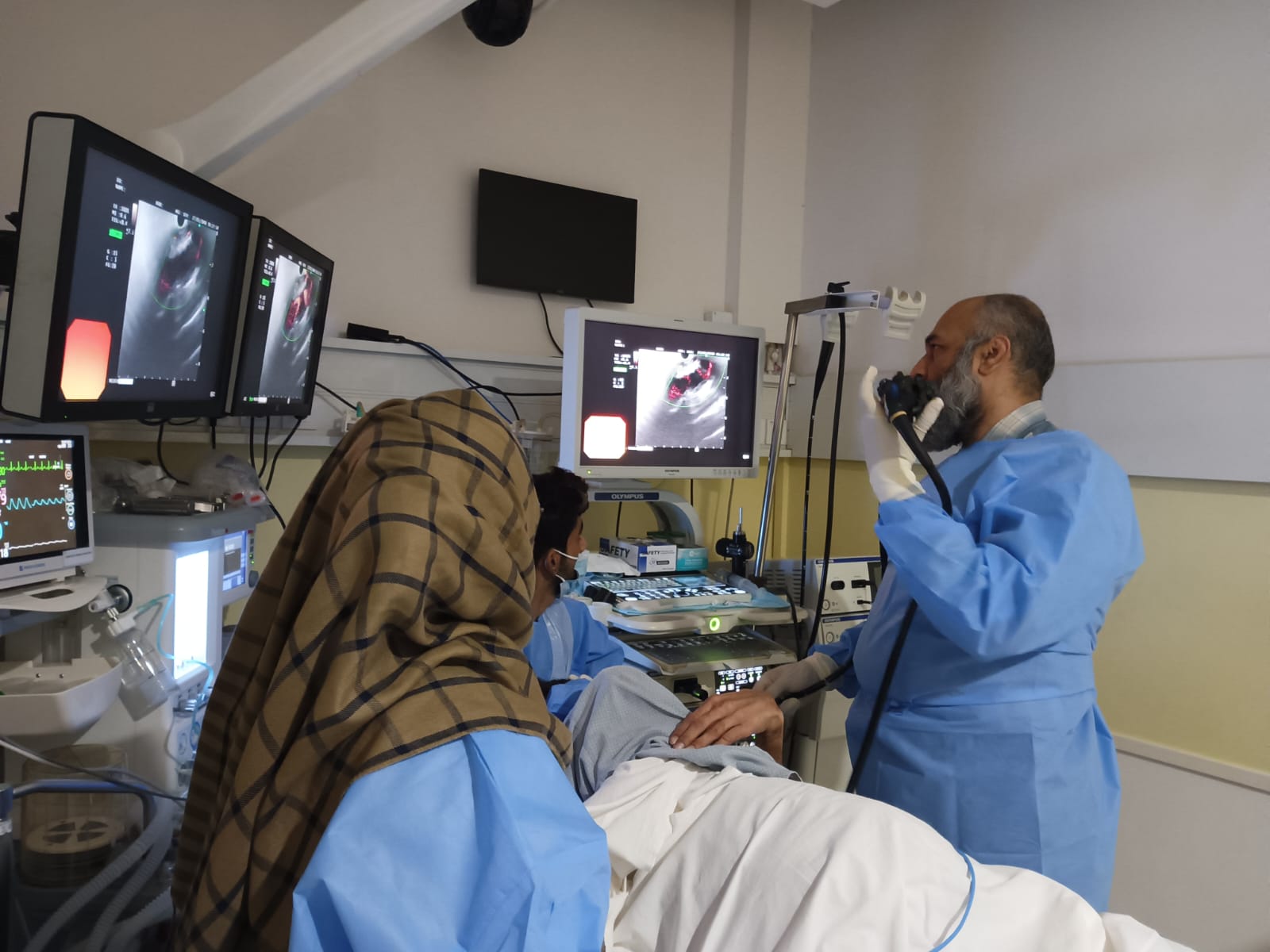
Most patients who are sent for an endoscopic ultrasound arrive with the same two questions, and neither of them is about the pancreas. They want to know whether it will hurt, and whether it is dangerous. The short answers: no, you are sedated and will not feel it, and no, this is a low-risk test in trained hands. What follows is the longer version — what EUS actually shows, why a CT scan often is not enough, and what the real risks are.
Endoscopic ultrasound (EUS), sometimes called echoendoscopy or endosonography, is an endoscopy with an ultrasound probe built into the tip of the scope. Instead of scanning through the abdominal wall, the probe sits inside your stomach or duodenum, a few millimetres from the pancreas, bile duct and gut wall.
Why EUS and not just a CT scan?
The pancreas sits deep in the abdomen with loops of gas-filled bowel in front of it. Gas reflects sound, so an ordinary abdominal ultrasound, the one done with a probe on your skin, often returns a report saying the pancreas was “obscured by bowel gas”. That phrase appears on a great many scans I review in clinic. A CT scan gets past the gas, but its resolution runs out at around a centimetre.
EUS removes the gas problem entirely by starting from inside. The practical consequence is resolution: it resolves lesions of a few millimetres, and it is the test that finds the small pancreatic tumour, the tiny stone in the lower bile duct, or the layer of the gut wall a tumour has reached.
| Abdominal ultrasound | CT scan | EUS | |
|---|---|---|---|
| Probe position | On the skin | Outside the body | Inside the stomach/duodenum |
| Blocked by bowel gas | Yes, often | No | No |
| Smallest lesion seen | ~2 cm | ~1 cm | 2–3 mm |
| Can take a tissue sample | No | Only via a needle through the skin | Yes, through the scope |
| Sedation needed | No | No | Yes |
That last row is the honest trade-off. EUS gives far more detail, but it requires sedation and a trained operator, so it is not a first-line screening test. It is the test you do when something needs to be settled.
Yeh test kab karte hain? (When is EUS indicated?)
Dr. Taj orders or performs EUS in a fairly narrow set of situations:
- Pancreatic masses and cysts: characterising a lesion picked up on CT, and staging it if it is a tumour.
- Unexplained pancreatitis: looking for small stones or sludge in the bile duct that imaging has missed.
- Staging gastrointestinal cancers: establishing how deep an oesophageal, gastric or rectal tumour has grown, which decides whether surgery or chemotherapy comes first.
- Subepithelial (submucosal) lumps: a bulge seen at ordinary endoscopy, where the question is which layer it arises from and whether it needs removing.
- Bile duct stones: confirming or excluding a stone before committing someone to ERCP.
- Tissue sampling: guiding a fine needle into a lesion that cannot be reached any other way. That is covered separately in the EUS-guided biopsy article.
- Enlarged lymph nodes next to the oesophagus or stomach, where the differential in Pakistan includes tuberculosis as often as malignancy — a distinction that matters enormously and that imaging alone cannot make.
That last point deserves emphasis, because it is where local practice diverges from what the Western textbooks assume. In Karachi, a cluster of enlarged mediastinal or peri-gastric nodes is not presumed malignant. Tuberculous lymphadenitis is common enough here that sampling those nodes changes the answer in a meaningful proportion of cases, and the treatment that follows is completely different. An EUS-guided needle settles it.
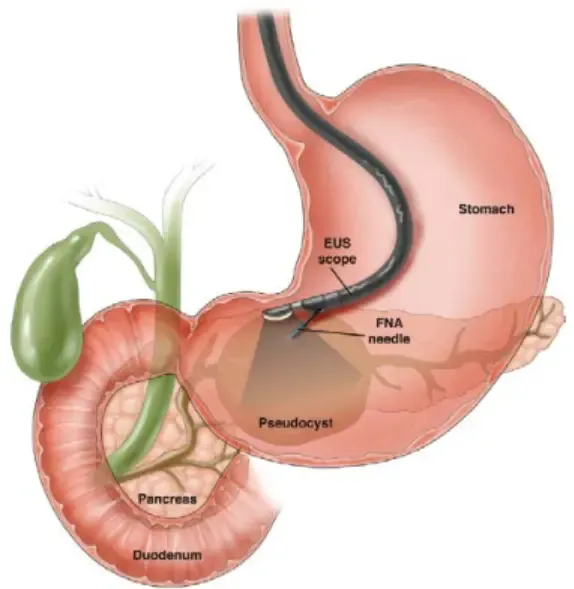
The echoendoscope positioned in the stomach, scanning the layers of the gut wall and the organs behind it. © Dr. M. Ali Taj
Is endoscopic ultrasound painful?
No. EUS is performed under intravenous sedation, and patients do not feel the scope going down or the scanning itself. Almost everyone tells me afterwards that they remember being wheeled in and then remember waking up. The most common complaint on the day is a mildly sore throat, and some bloating from the air and water used to get clear images.
The bloating is worth explaining because it surprises people. To scan properly, the balloon at the scope tip is filled with water and the stomach is partly distended. That is what leaves you feeling full and gassy for a few hours afterwards. It is not a complication, and walking around helps it settle faster than lying still.
Procedure se pehle taiyaari (Preparing for EUS)
- Fasting. Nothing to eat for at least 6 hours before. Clear water may be allowed up to 2 hours before — confirm this with the endoscopy unit, because the instruction depends on the sedation plan.
- Blood thinners. Tell Dr. Taj about them well in advance, not on the day. If a needle sample is likely, they may need to be paused, and that decision has to be weighed against the reason you are on them in the first place. Do not stop them yourself.
- Diabetes. Ask about your morning dose when you book, since you will be fasting.
- Other conditions. Heart or lung disease, previous reactions to sedation, allergies, prior abdominal surgery — all of it changes the plan.
- Bring someone. You cannot leave alone.
For a lower EUS, examining the rectum, you will also need bowel preparation, similar to a colonoscopy.
Procedure kaisa hota hai? (What happens on the day)
You change, a cannula goes in, and monitoring goes on — oxygen, pulse, blood pressure. Sedation is given intravenously. Dr. Taj passes the echoendoscope through the mouth, down the oesophagus, into the stomach and duodenum, scanning as it goes. The images appear live on a screen beside the bed.
If something needs sampling, a fine needle is passed down the working channel of the scope and into the target under real-time ultrasound guidance. The needle is thin, and it is watched on screen for the whole of its travel.
Most diagnostic EUS takes 30 to 45 minutes. Add time if sampling is needed, or if the anatomy is difficult — up to about 90 minutes. Then one to two hours in recovery while the sedation wears off.
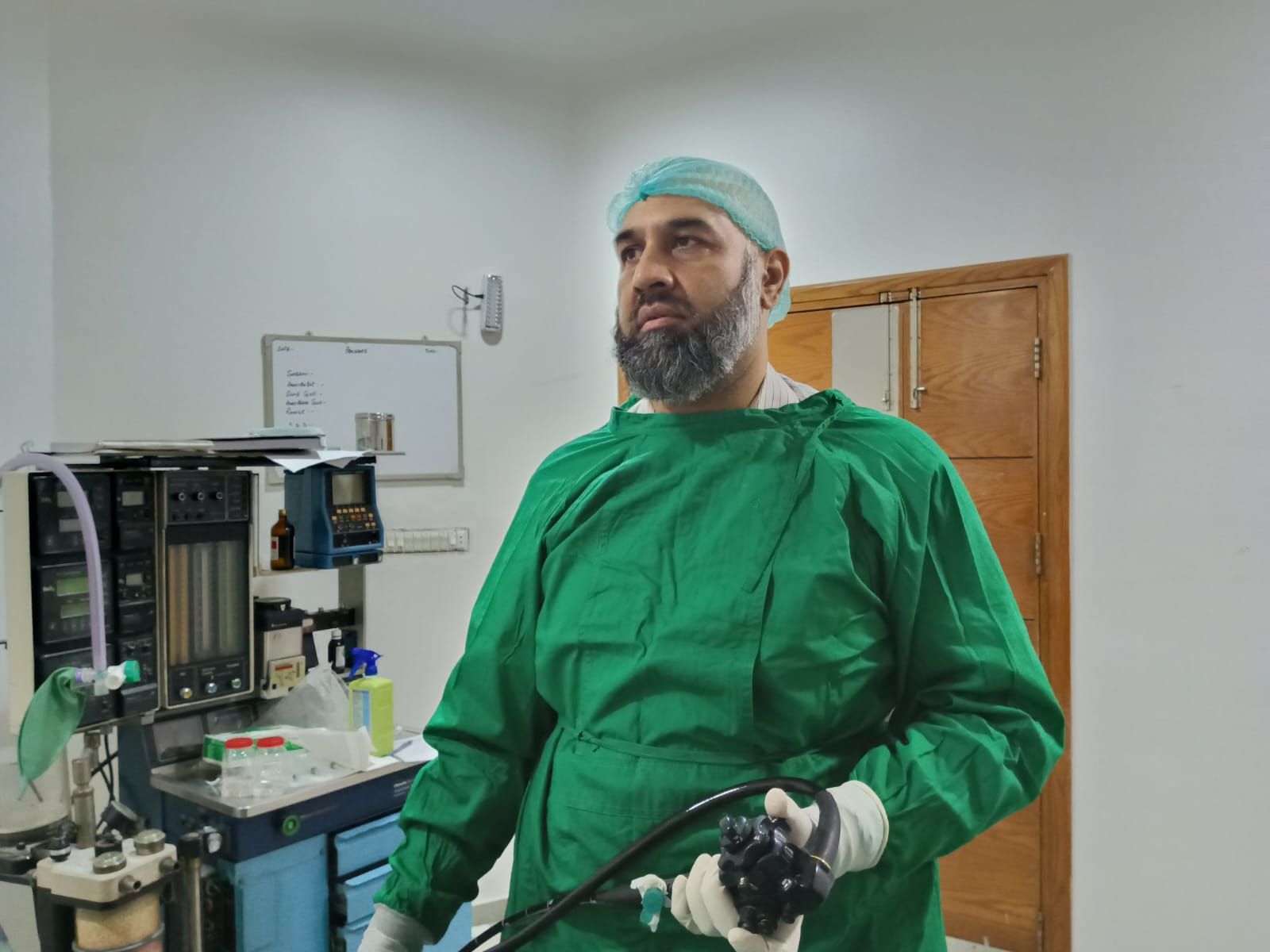
Dr. M. Ali Taj preparing therapeutic equipment before an EUS list. © Dr. M. Ali Taj
What are the side effects of endoscopic ultrasound?
Diagnostic EUS without sampling is about as safe as an ordinary gastroscopy. The American Society for Gastrointestinal Endoscopy puts it plainly in its adverse-events guidance:
Diagnostic EUS is a safe procedure with a low rate of adverse events, comparable to that of standard upper endoscopy; the majority of reported adverse events occur in association with EUS-guided fine-needle aspiration.
Realistically, here is what to expect and what to watch for:
Common, and not a cause for concern
- Sore throat for a day
- Bloating and wind for a few hours
- Drowsiness and poor concentration for the rest of the day
Uncommon
- Bleeding, usually minor, and almost always after needle sampling
- A reaction to the sedation
Rare
- Pancreatitis: the one specific to EUS, and only after a needle passes through or into the pancreas. This is precisely why sampling is not done reflexively. If the result will not change what happens next, the needle stays in its packet.
- Perforation: a tear in the gut wall. Rare, and rarer still in high-volume hands.
- Infection: mainly after draining a cyst or fluid collection, which is why antibiotics are given for those procedures.
When to seek help urgently
Go to an emergency department, or call, if in the hours or days after your EUS you develop:
- Severe or worsening abdominal pain, especially pain boring through to the back
- Fever or shaking chills
- Vomiting blood, or black tarry stools
- Chest pain, breathlessness, or difficulty swallowing your own saliva
These are uncommon. But pancreatitis and perforation both announce themselves as pain that gets worse rather than better, and both are far more manageable when seen early.
Recovery aur aftercare
You will be drowsy. Eat something light once the throat spray has worn off and swallowing feels normal — usually an hour or two. Normal food the next day. Most people go back to work the following morning.
Do not drive, operate machinery, sign anything legally binding, or look after a small child alone for the rest of the day. Sedation impairs judgment for longer than it impairs alertness, which is the part people underestimate.
Dr. Taj will usually tell you what the images showed before you leave. Needle sample results take several working days, since the tissue goes to a pathologist.
Karachi mein EUS — Dr. Taj ke saath
EUS is operator-dependent in a way that most tests are not. The images are generated and interpreted in real time by the person holding the scope, and there is no radiologist reading it afterwards. Volume matters, and so does training.
Dr. Muhammad Ali Taj is a consultant gastroenterologist and interventional endoscopist in Karachi with 28+ years in practice and over 14,000 endoscopic procedures performed, including diagnostic and therapeutic EUS and ERCP. His qualifications include FCPS (Gastroenterology), MRCP Gastroenterology (UK), SCE (UK) and ESEGH, the European Specialty Examination in Gastroenterology and Hepatology. He has 14 peer-reviewed publications, listed on his Google Scholar profile and ORCID.
He practises at:
- Ziauddin Hospital, Clifton
- Hill Park General Hospital
- Life Care Consultant Clinics
- Usman Memorial Hospital
More on his background is on the about page, and the procedure itself is summarised on the EUS procedure page.
Aksar puchhe jaane wale sawaalat (FAQs)
Is endoscopic ultrasound painful? No. EUS is done under intravenous sedation, so you are asleep for the part that would be uncomfortable. Most patients remember nothing of the procedure itself. The usual complaint on the day is a mildly sore throat, and some bloating from the air and water used during scanning. That settles within a day.
What are the side effects of endoscopic ultrasound? The common ones are minor and short-lived: sore throat, bloating, drowsiness from the sedation. Serious complications are uncommon. Bleeding and perforation are rare. The one specific to EUS is pancreatitis after a needle biopsy of the pancreas, which is why sampling is only done when the result will change your treatment.
How is EUS different from a normal ultrasound? A normal abdominal ultrasound scans from outside, through skin, fat and bowel gas, which blurs the pancreas badly. EUS puts the probe inside the stomach and duodenum, millimetres from the pancreas and bile duct, with no gas in the way. It picks up lesions a few millimetres across that an external scan and often a CT will miss.
Do I need to be admitted overnight for an EUS? Usually not. Diagnostic EUS is a day procedure. You come in fasting, spend 30 to 90 minutes in the endoscopy suite, then one to two hours recovering while the sedation wears off. Therapeutic EUS, such as draining a pancreatic collection, may need a short admission.
How long do EUS results take? Dr. Taj can usually tell you what the images showed the same day, once you are awake. If a needle sample was taken, the cytology or histology report takes several working days, because the tissue has to be processed and read by a pathologist.
Can I drive myself home after EUS? No. Sedation stays in your system for the rest of the day even though you feel alert. You need someone to take you home, and you should not drive, sign documents or return to work until the next morning.
This article is for general information and does not replace a consultation. Decisions about whether you need an EUS, and what to do with the result, depend on your own history and imaging.